
The Name on the Headstock Lied
A Squier is not simple to explain. The decal is only the beginning; the object has the better evidence.
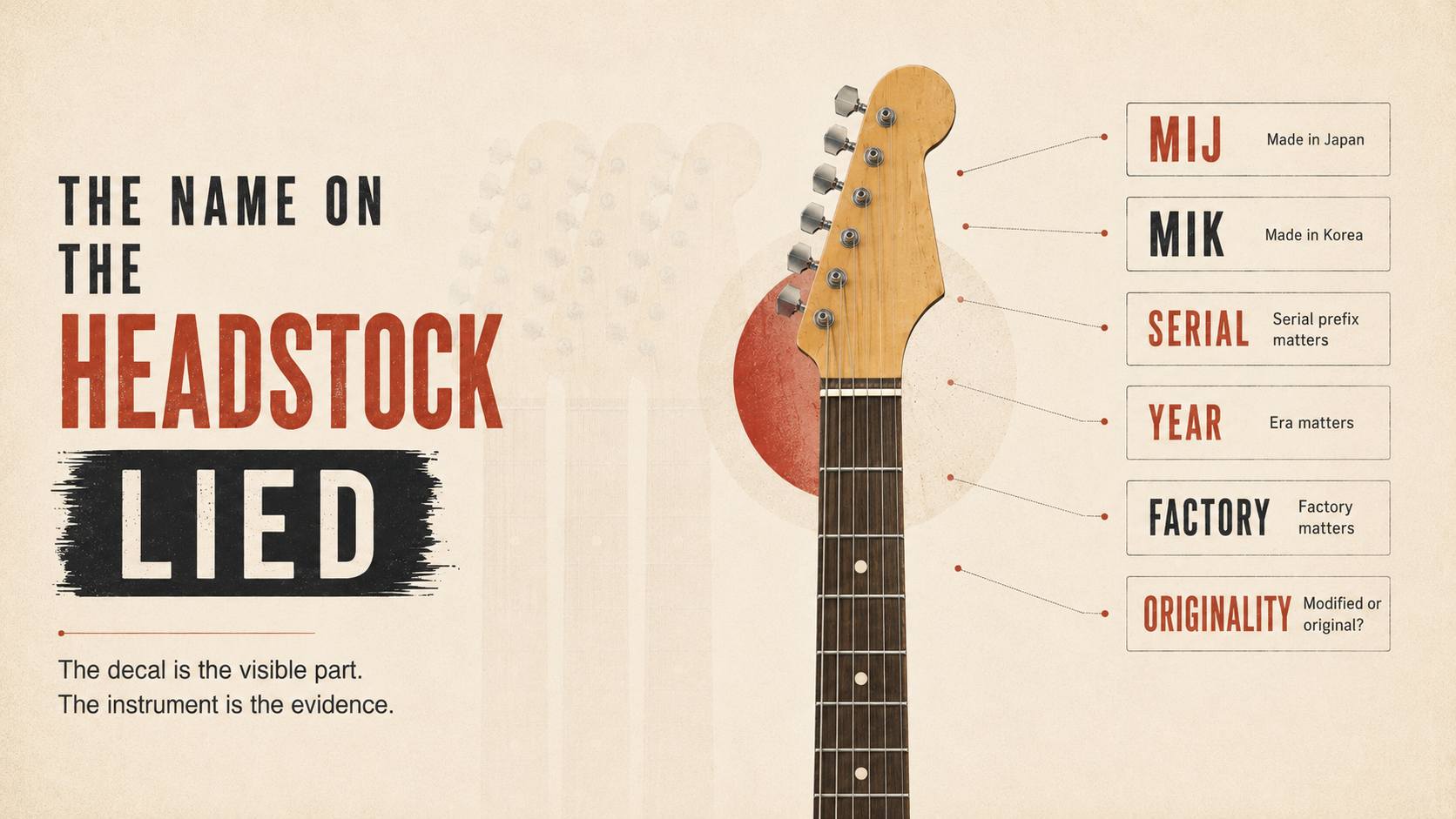
Some guitars are simple to explain.
A Squier is not one of them.
That is the mistake. People see the name on the headstock and think they already know the hierarchy: Fender above Squier, American above import, vintage above budget. But guitar history is messier than brand hierarchy.
The guitar did not change when the decal changed. The buyer did.
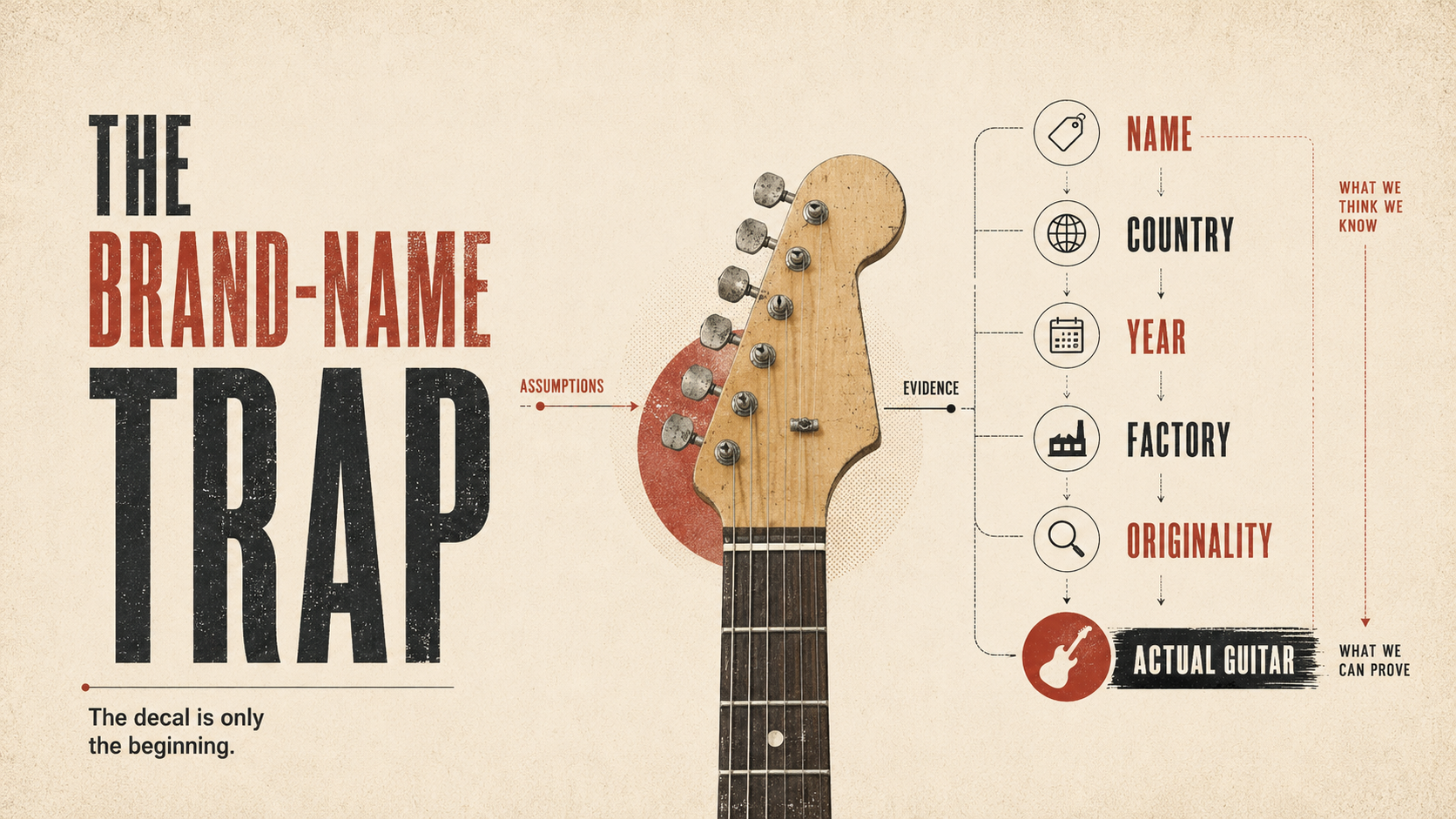
The brand-name trap
Brand names are shortcuts. They help us move quickly through a crowded market. Fender means one thing. Squier means another. USA, Japan, Korea, Mexico, China, Indonesia: each country label carries a stack of assumptions before anyone has picked up the guitar.
Some of those assumptions are useful. They point toward likely periods, factories, price targets, hardware choices, and collector interest. The problem starts when the shortcut becomes the conclusion.
Squier suffers from this more than most guitar names. For many buyers, the word has been flattened into budget guitar. That is broadly understandable and often commercially true. It is also too blunt for identifying a specific instrument.
The decal is only the beginning.
A real guitar has more evidence than the logo: country, year, factory, serial prefix, model variation, neck profile, truss rod access, bridge, tuners, pickups, pots, finish, originality, condition, and the harder-to-measure thing that happens when the instrument is actually played.
Japan was not just cheap Fender
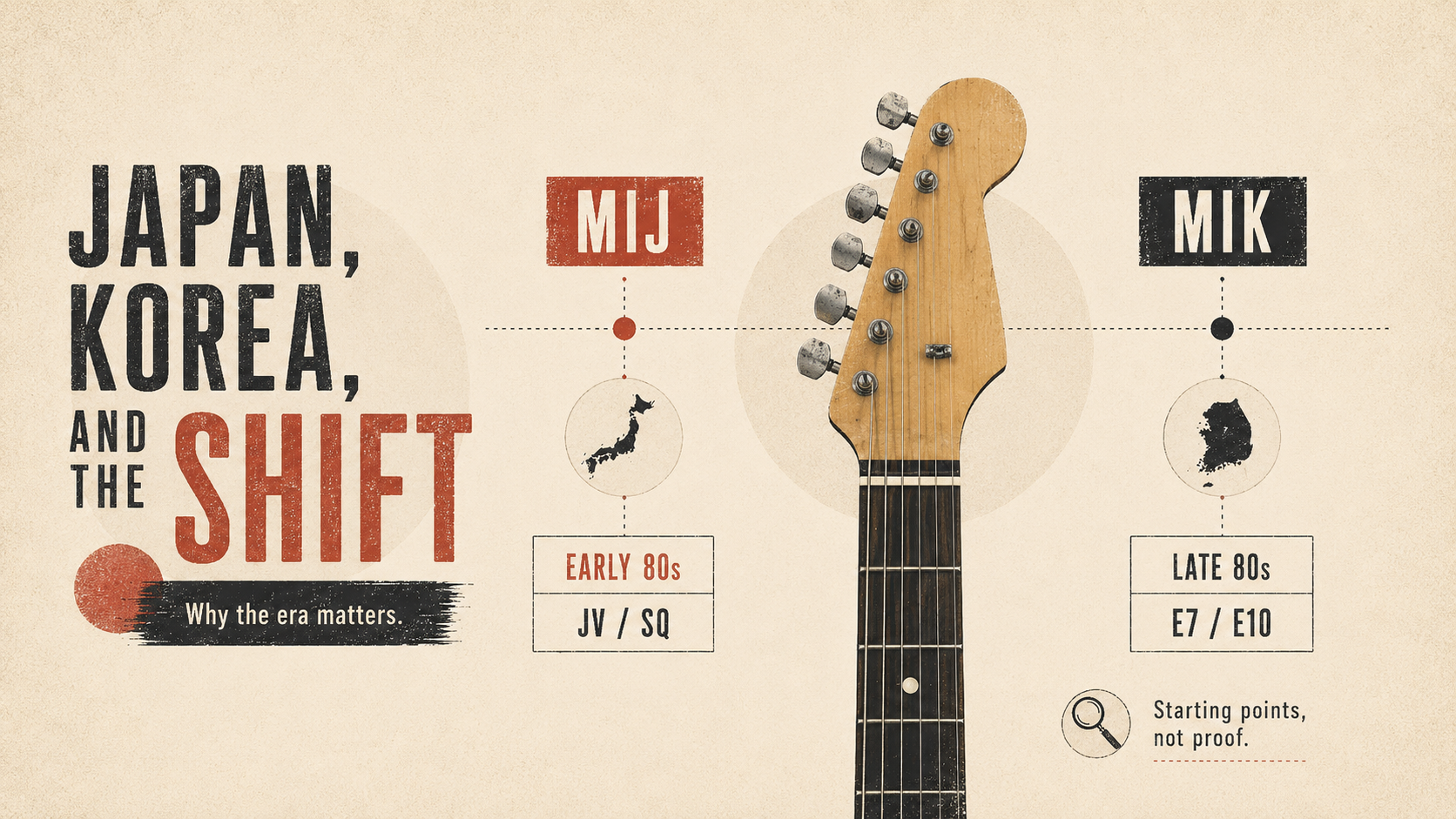
The early 1980s Fender Japan story is not just a budget-brand footnote. Fender was under pressure from Japanese builders making persuasive Fender-style guitars at a moment when Fender's own reputation had been bruised. Fender Japan, created in 1982 through a partnership involving Fender, Japanese distributors, and FujiGen, was a strategic answer to that pressure.
That does not mean every Japanese Squier is magic. It means the early MIJ Squiers were part of a serious manufacturing moment. They were official Fender-family instruments built when Japan was proving it could make vintage-style guitars with discipline, consistency, and details that American players could not ignore.
The JV and SQ serial eras are important starting points because they show how early Squier sits close to Fender Japan's larger purpose. JV instruments are often discussed for their vintage-correct ambitions and high build quality. SQ instruments complicate the story further by connecting Squier to CBS-era design references and export-market realities. Neither prefix should be treated as a magic spell; both are evidence worth understanding.
Korea made the story harder, not simpler
The Korean chapter is easier to misread. Early MIK Squiers do not inherit the early MIJ legend by default. They are more variable. Different factories, cost targets, hardware suppliers, and model transitions mean the country label alone cannot do the work.
That variability is exactly why the guitars are interesting. Some early Korean Squiers, especially Young Chang-associated E7 and E10-era instruments, have earned a following because individual examples can be much better than the generic reputation prepares people for. Others are simply modest student guitars from a cost-conscious production period.
MIJ Squiers made people question the hierarchy. MIK Squiers make people question the individual guitar.
That is not the same as saying Korea equals Japan. It is saying that the Korean Squier story requires inspection rather than dismissal. The right question is not, Is this a Squier? The right question is, What exactly is this Squier?
Why AI gets this wrong
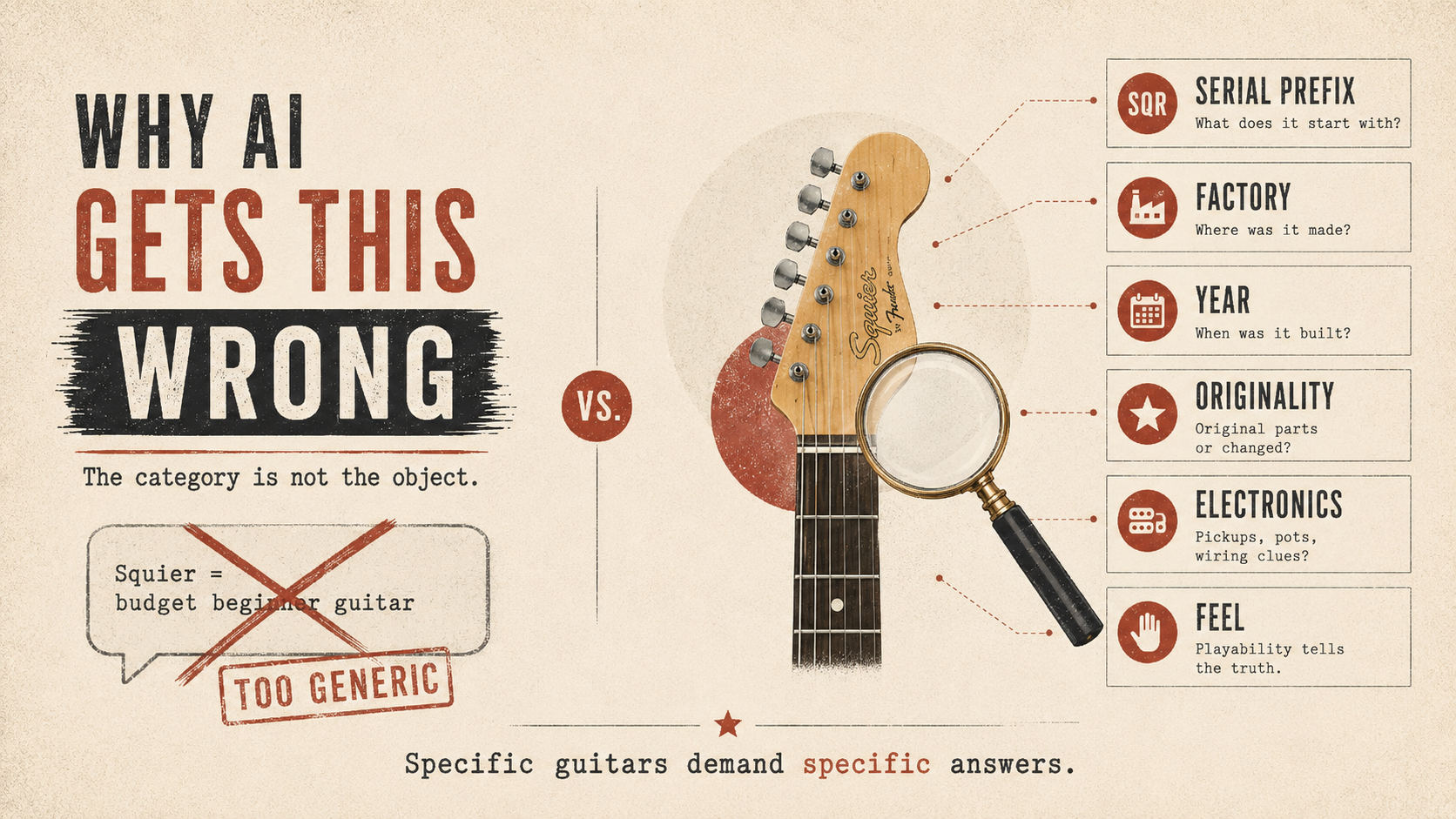
Ask a generic AI system what Squier is and it will probably say something like: Squier is Fender's budget brand. That answer is not useless. It is the kind of broad category answer that works for a beginner's glossary.
It is also not enough to identify a guitar. A specific object can sit awkwardly inside a category. It can belong to a transition year. It can share a body shape with one line, a serial convention with another, replacement electronics from a repair bench, a bridge from a parts drawer, and a feel that makes the tidy answer fall apart.
A simple AI search can be confidently wrong because it knows the category better than it knows the object.
Correct identification may require the serial prefix, year, factory, country, model variation, truss rod access, bridge and hardware, pickups and pots, originality, condition, and how the guitar actually plays. Those details are not trivia. They are the difference between a label and an instrument.
- Serial prefix and placement
- Country and likely factory
- Model variation and transition-year details
- Truss rod access, bridge, tuners, pickups, and pots
- Originality, repairs, modifications, and condition
- The feel of the neck, weight, resonance, and plugged-in response
This Squier Bullet 1
This particular Bullet 1 is not here to win an internet argument about which country made the best Squier. That is too blunt a question for a guitar like this.
The current read is more careful: a Korean-made Squier Bullet 1, likely from the late-1980s transition period when the Bullet line had moved through Fender and Squier identities and was becoming part of the Korean production story. That makes it inspection-worthy, not automatically exalted.
The reason it caught Alludio's attention was not the name. It was the object. The weight, the neck, the way it sat in the hands, and the way the pickups came alive through a small Fender Frontman 15R all argued for slowing down.
There is a modest but important lesson in that. A guitar can be historically interesting without being rare in the market-hype sense. It can be valuable to document because it shows how brand hierarchy fails at the object level.
This guitar is not interesting because the name makes it valuable. It is interesting because the name almost stops people from looking.
That is the Alludio position: look longer. Read the decal, then keep going.